Tuesday, May 17, 2011

Thurow on Cognitive Science and Religious Belief (Part Three)


(Part One, Part Two)

This post is the last in a brief series on Joshua Thurow’s article:

“Does Cognitive Science Show Belief in God to be Irrational? The Epistemic Consequences of the Cognitive Science of Religion” (2011) International Journal of the Philosophy of Religion

It is part of a broader series of posts on evolutionary debunking arguments (EDAs). These arguments claim that if a belief-forming faculty is the product of a process that does not track the truth with respect to the relevant class of propositions, then any beliefs produced by that faculty are unjustified.

Thurow’s article focuses on evolutionary accounts of religious belief and the implications of such accounts for the rationality of religious beliefs. We finished the last part by outlining Thurow’s second (and more robust) version of the religious belief debunking argument. He calls it the CSR Process Defeater Argument.

Although this argument has successfully weathered some criticism, Thurow thinks it is susceptible to another line of criticism. Let’s see what this is.

(You might like to keep part two, with the process defeater argument, open in another tab or window for reference purposes).


1. Propositional and Doxastic Justification
The process defeater argument, in the form we have been considering, has a relatively simple structure. It begins by specifying that people believe in God in a non-inferential or basic manner due to the presence in them of a cognitive faculty (the HADD) that generates such beliefs. It then points out that the cognitive faculty in question is not a reliable producer of such beliefs because it would produce such beliefs even if they were not true. It concludes that religious belief is unjustified.

It might be tempting to object to the argument on the grounds that it commits a kind of genetic fallacy: It impugns people’s beliefs on the grounds that they originate in the HADD, but fails to address the possibility that they might have other (justified) grounds for holding those beliefs.

Tempting as it seems, this response is mistaken. To see why, it is useful to distinguish between propositional and doxastic justification. Your belief is propositionally justified when you have good reasons for believing as you do. Your belief is doxastically justified when the reasons you actually use to justify your belief are good reasons. The distinction is subtle, but crucial, because a belief might be propositionally justified even when it fails to be doxastically justified.

How does the distinction apply to the argument at hand? Well, the idea is that while people may have good reasons at their disposal for justifying their religious beliefs, they do not actually rely on those reasons. The actual grounding for their beliefs (the one they rely on) is non-evidential and is attributable to the HADD (or similar faculty) and that grounding, as we have seen, is unjustified. Obviously, this claim could not cover all religious believers, but maybe it covers a good proportion of them?


2. Engaging with the Real Reasons for Belief
Not so fast, says Thurow. He doesn’t think the argument works even when targeting doxastic justification. The reason is that the cognitive scientists claims about the origins of religious belief are unrealistically general.

Take, for example, defenders of the HADD-theory. According to them, certain strange events tend to be attributed to supernatural or divine agents due to the presence of a HADD. As such, their claims only cover a general kind of religious belief, not a theologically and culturally specific kind such as Christianity. The general belief uses abstract, minimally counter-intuitive concepts that are filled in by a whole host of contextual and cultural factors.

When justifying their specific beliefs, religious believers will appeal to a wide diversity of reasons including, but not limited to: they think they have witnessed miracles; they believe the Bible is reliable; they think certain of their prayers get answered; the world seems to have been designed for certain theologically significant purposes; and so on. Such reasons are necessary to move from the general to the specific.

This is a problem for the process defeater argument. To show that a believer’s specific religious beliefs are doxastically unjustified, an opponent would have to engage with all those reasons on their own merits, i.e. by engaging with the arguments and principles used to defend those beliefs. Some of those reasons might be bad, but learning this would be no different from the usual philosophical game. And it would imply that the cognitive science theories by themselves cannot change the contours of the philosophical debate over the rationality religious beliefs.

For those of you referring back to the argument itself, Thurow’s objection seems to attack premise (7). Still, he goes on to claim that it does not directly threaten basic belief religious epistemologies. I’m not really sure what his argument for this is since this part of the article is brief and simply describes a number of basic belief positions.

My guess is that Thurow is pointing out that basic belief style epistemologies (particularly of the Plantingan-variety) appeal to epistemically possible models of warrant and that these models can only be challenged using concepts not advanced by the CSR process defeater argument. According to such models, it is possible, for all we know, that God created us with cognitive faculties that allow us to have direct experiences of his existence. And since many believe they have had such experiences, they are warranted (absent defeaters) in believing in his existence. Such a model can be challenged on the grounds that we have no good reason for thinking God would create us with such a faculty, but this is very different from saying that our religious belief-forming cognitive faculties were by-products of evolution.


3. A Final Rejoinder
Even if all this is successful, one might still object to religious beliefs on the grounds that our argument-evaluating faculties are also unreliable. For example, one might argue that we are biased or predisposed towards finding arguments in favour of a belief in God and so we shouldn’t even trust the way in which we evaluate arguments for religious beliefs. This is certainly not implausible. Hugo Mercier and Dan Sperber have recently put forward the hypothesis that our reasoning faculties have evolved not to pursue the truth but to persuade others of conclusions we already accept.

Thurow responds to this line of argument in a couple of ways. First, even if we favourably evaluate arguments for the existence of gods in general, a specific argument for the existence of a specific god might easily be undermined. Indeed, this seems to true HADD across the entire range of agents (both natural and supernatural). And second, confirmation biases presumably work across a diverse array of propositions. Some of these biases might work against religious beliefs and thus make them more difficult to sustain.


4. Conclusion
To sum up, debunking arguments maintain that certain beliefs are unjustified because they are produced by unreliable belief-forming processes. The CSR process defeater argument is an example of such an argument. It specifically targets the rationality of religious beliefs. Although the argument is a strong one, and survives several lines of attack, it is not completely persuasive. This is because modern scientific theories of religious belief formation describe such belief formation in an unacceptably general manner: they fail to engage with the real reasons that people offer for specific religious beliefs. The only way to engage with those reasons it to perform the usual philosophical analysis of the strengths and weaknesses of these reasons. In doing that, one must abandon the debunking argument.

Monday, May 16, 2011

Thurow on Cognitive Science and Religious Belief (Part Two)


(Part One)

This is the second part in a brief series on Joshua Thurow’s article:
Does Cognitive Science Show Belief in God to be Irrational? The Epistemic Consequences of the Cognitive Science of Religion” (2011) International Journal of the Philosophy of Religion
This is part of a broader series of posts on evolutionary debunking arguments (EDAs). These arguments claim that if a belief-forming faculty is the product of a process that does not track the truth with respect to the relevant class of propositions, then any beliefs produced by that faculty are unjustified.

Although he does not use the terminology of the EDA, Thurow’s article is very definitely a contribution to the burgeoning literature on this topic. As we saw in part one, he focuses specifically on the implications of so-called by product theories of religious belief formation. According to these theories, religious beliefs are by-products of cognitive faculties that have evolved for other purposes. The classic example being the HADD-theory, which maintains that belief in divine agency is the product of a hyperactive agency detection device.

Thurow’s goal in the first two-thirds of his article is to present a robust version of a religious belief debunking argument based on the by-product theory. I introduced his first version in the previous entry. Things seemed to be going well for this version: it had been challenged from a couple of different directions and appeared capable of withstanding the assault.

But alas things are not so easy. In this part, I’ll present Thurow’s own criticism of this first version of the argument. I will then present his alternative version of the argument (the “process defeater argument”) that responds to this criticism.


1. Problems for the Reliability Test
The version of the debunking argument discussed in part one proposed the following test for the reliability of a belief-forming process:


  • (6) If a process would produce a belief in X even if X did not exist/occur, then that process is unreliable.


This reliability test impugns the HADD since it would produce belief in God or gods even if such beings did not exist. The test has already survived one type of criticism, but Thurow thinks there is another type of criticism that it does not seem to survive.

The criticism employs an analogy with mechanical or computational devices created by human beings. Thurow points in particular to the example of an astronomical device that gives us the locations and distances to all the planets and moons in our solar system. This device is programmed by human beings who have solid evidence for all the relevant coordinates and distances. As a result, we who use the device will trust in what it tells us and it looks like we are within our epistemic rights to do so.

But here’s the problem: the device whose outputs we are trusting does not pass the reliability test proposed by Thurow. Once again, if it turned (perhaps per impossibile) out that the planet Mars was not in the location specified by the device, the device would still specify that location. This is because the device is not sensitive to real world changes. Nevertheless, it seems like our trust in the device remains warranted because it was designed in accordance with sound design principles.

The analogy is apt because according to theists we are in a similar position with respect to our own belief-forming faculties. They, after all, believe that these faculties were designed by God, a being who surely knows of his own existence and can reliably program us to believe in his existence. And we, therefore, can be justified in believing in his existence

This, of course, echoes the Plantingan position.


2. Responding to the Objection
What are we to make of this objection to the reliability test? Maybe very little. When it comes to the astronomical device, our trust seems warranted because we know that the designers of such devices rely on sound principles and evidence. When it comes to our own cognitive faculties, we know no such thing.

Imagine if you came across a device, carelessly strewn on the heath, which purported to give you the locations and distances to all the planets and moons in our solar system. Upon closer investigation, you discover that the device takes no inputs from the external environment (e.g. no telemetry from satellites), that it just produces outputs in the form of the information described. Should you trust such a device? Maybe. But only if you had independent means of confirming or validating its results.

It seems like we are in a similar position when it comes to belief in God as produced by the HADD. We just have a device, that produces a particular kind of belief as an output (even in cases where the object of the belief is absent). So unless we have some independent means of verifying or confirming the reliability of that output, we have nothing that would count as the basis of a warranted belief.

It’s important to see that this response does not lead to global scepticism. Thurow is not claiming that we should only trust the output of our innate faculties when we have independent evidence for the reliability of those faculties. He is claiming that in the specific case where we have a faculty that produces a belief in X even when X is not present, we should suspend judgment about the reliability of such a faculty.


3. A New Argument
All of the preceding discussion leads Thurow to draft a new version of the debunking argument. He calls it the “CSR (Cognitive Science of Religion) Process Defeater Argument”. It looks like this (note: I’ve reordered the premises and added an intermediary conclusion to the version that appears in the Thurow’s article):


  • (7) If theory T is true, then religious beliefs are produced and sustained by process P, which is a basic belief forming process.
  • (8) There is no independent process to validate the reliability of P (from 7)
  • (9) Process P has the following feature: if religious beliefs were not true (i.e. no god existed), then P would still produce religious beliefs.
  • (10) If the process by which a belief X is formed and sustained is structured in such a way that if X were false, the process would still generate belief that X (and the process is not an inductive argument), then we should suspend judgment about the reliability of that process with respect to X, in the absence of independent evidence for the reliability of the process.
  • (11) Therefore, we should suspend judgment about the reliability of process P with respect to our religious beliefs.
  • (12) If we should suspend judgment about whether the belief-forming process we use is reliable with respect to X, then we are not justified in believing X.
  • (13) Therefore, if theory T is true, our religious beliefs are not justified.


Most of this argument makes sense in light of the preceding discussion. Premise 10 now states the new reliability test and adds the qualifications that result from the challenges and objections to the original version. Premise 12 seems like a sensible epistemic principle: one cannot justifiably believe in something about which one must suspend judgment. And the overall conclusion does indeed seem to follow.

So have we done it now? Have we constructed a watertight debunking argument based on the cognitive science of religion? The answer is “no”; there is another line of objection that undermines this version of the argument. We’ll see what it is in the final part.

Saturday, May 14, 2011

Thurow on Cognitive Science and Religious Belief (Part One)


I’ve recently been covering evolutionary debunking arguments (see index of posts here). These are a sub-class of the more general naturalistic or causal debunking arguments. Such arguments suggest that if a belief (X) is produced by a causal process (P), and if that process is not reliable or truth-tracking with respect to X, then belief in X is unjustified or unreliable. Evolutionary debunking arguments obviously focus solely on the causal process of evolution.

Debunking arguments of this sort can be deployed to cover a range of beliefs. Joshua Thurow’s recent article:
Does Cognitive Science Show Belief in God to be Irrational? The Epistemic Consequences of the Cognitive Science of Religion” (2011) International Journal of the Philosophy of Religion

is concerned with the impact of evolutionary explanations of our religious belief-forming faculties on the rationality of religious belief (specifically, belief in God).

I’m going to summarise Thurow’s argument over the next few posts. Since a large portion of what Thurow says in introducing his argument has been covered elsewhere in the series on debunking arguments, I’m going to try and cut straight to the chase. In this part I’ll outline his simple version of the debunking argument. In the next part, we’ll consider an objection to this version and develop a stronger one.

The only thing I will say now, in the interests of setting the scene, is that although Thurow acknowledges that there are three basic types of theories in the cognitive science of religion (adaptationist, by-product, and exaptationist), his analysis is limited to by-product theories. But he thinks his arguments can, pardon the pun, be exapted to cover the other theories as well.

The by-product theory suggests that our religious beliefs are the by-products of cognitive faculties that have evolved for other purposes. The best-known and most widely-cited example being the faculty for agency detection. This faculty is what allows us to attribute events and states of affairs to the actions and intentions of other agents. It produces belief in supernatural agents because it is hyperactive (hence, it is sometimes called the hyperactive agency detection device or HADD).


1. Thurow’s First Version of the Argument
One of the nice things about Thurow’s article is that although he is ultimately rejects the use of debunking arguments in challenging religious beliefs, he does try to give a decent formulation of the argument. He does this in two parts. First, he develops a relatively simple version of the argument. He then finds this to be deficient and formulates a stronger version. We’ll look at the simpler version first. It runs like this:


  • (1) If theory T is true, then religious beliefs are produced and sustained by process P (in this case as a by-product of other cognitive faculties or “Pbp”).
  • (2) Process P is unreliable and does not make use of good evidence.
  • (3) If the process by which a belief is formed and sustained is unreliable and does not make use of good evidence then that belief is unjustified.
  • (4) Therefore, religious belief is unjustified.


The structure of this argument should be familiar to anyone who has read the other entries on debunking arguments. One nice feature is that premise (3) is agnostic as to whether epistemic internalism or externalism is to be preferred.

The key to the argument is premise (2). Focusing on the by-product theory (or process Pbp), we must ask: what grounds do have for thinking that this process produces unreliable and evidentially deficient beliefs? The answer, according to Thurow, comes from the following argument (this is my interpretation of his reasoning):


  • (5) If the by-product theory is true, then even {if there were no God or gods, we would still believe in their existence}.
  • (6) If a process would produce a belief in X even if X did not exist/occur, then that process is unreliable or uses poor evidence.
  • (7) Therefore, process Pbp is unreliable and does not make use of good evidence.


The First Argument (Slightly Cleaned-up)


There are two key premises here. Premise (5), which is a counterfactual claim about the nature of the by-product process of forming beliefs; and premise (6), which proposes a principle for testing the reliability of a belief-forming process.

Premise (5) would usually be defended by reference to the various kinds of experiment that cognitive scientists perform on the HADD. These experiments reveal that the HADD produces a belief in the existence of agents even when they are not around. That said, premise (5) can still be challenged by some forms of theism. Premise (6) can also be challenged on the grounds that it is not a good test. We’ll consider both of these objections briefly.


2. The Anselmian Objection
The first objection comes from the Anselmian theist. According to them, God cannot not exist because God is a necessary being. This means that the first part of the counterfactual proposed in premise 5 (the first part of the counterfactual within the squiggly brackets, that is) is impossible.

Why is this an issue? Well, it is traditionally supposed that counterfactuals with impossible antecedents (so-called counterpossibles) have trivial truth values. Hence they pose no significant challenge to the views being challenged. This point is often marshaled in defence of Divine Command Theories of morality (for example, the classic Euthyphro-inspired objection “what if God commanded something terrible...” is said to have an impossible antecedent and hence not a true objection to the theory).

There is a by-now standard response to this kind of objection. It is to point out that many disputes in philosophy turn upon the acceptation or rejection of necessary propositions, and that there doesn’t appear to be anything circumspect or trivial about these disputes.

There is another kind of objection that the theist can make. It is to argue that we depend necessarily on God for our existence (and for our belief forming faculties) and so once again the counterfactual required by Thurow’s arguments has an impossible antecedent.

This objection can be responded to using the same response as was adopted above, but there is also another kind of response that is particular to this objection. It is to point out that the reliability of a belief-forming faculty is distinct from its dependence on something else, and that it is thus right and proper to investigate the former by imagining scenarios in which the latter does not hold true.

Thurow illustrates this with an example. Imagine Jones, an ordinary man who, due to wishful thinking, believes that there is a beer in his fridge. Now suppose that there really is a beer in his fridge and that this beer is pressed down upon a button. The button is linked to some explosive device such that, if Jones removes the beer from the fridge, he will be instantly blown up.


In this scenario, two facts appear to be true: (i) Jones’s existence depends upon the actual presence of a beer in the fridge; and (ii) Jones’s belief that there is a beer in the fridge is formed by an unreliable process (that of wishful thinking). This suggests that the reliability of a belief that P, is not always sustained by a dependency relationship between P and the believer in P. This, according to Thurow, suggests that even if there is some kind of dependency relation between religious believers and the object of their beliefs, it is still right and proper to question the processes through which they form such beliefs using counterfactuals of the kind outlined in his argument.


3. The Reliability Test
The other potential bone of contention with Thurow’s initial defence of the debunking argument is the actual test it proposes for reliability, which was:


  • (6) If a process would produce a belief in X even if X did not exist/occur, then that process is unreliable.


The problem is that this test seems not to apply to certain kinds of inductive (Bayesian) inferences. Here’s an example from the philosopher Jonathen Vogel:

Two policemen confront an armed mugger who is standing some distance away. One is a rookie and one is a veteran. The rookie attempts to disarm the mugger by firing a bullet down the barrel of the mugger’s gun. The chances of pulling this off are virtually nil. The veteran knows what the rookie is trying to do. When it comes to the actual firing of the shot, the veteran can’t see the outcome. However, based on his years of experience, and his knowledge of the chances of success, he believes (correctly as it turns out) that the rookie probably missed.

I suspect most people will think that the veteran’s belief, in this kind of scenario, was reasonable. He is making a plausible inference about the likely success of the rookie’s shot based on his background knowledge acquired after years of experience.

The problem for Thurow is that the veteran’s belief would be impugned if we were to use his proposed reliability test. After all, the veteran would have made the same kind of inference even if the rookie’s shot had been successful.

Thurow concedes that this is a counterexample to his proposed reliability test, but he his undeterred for two reasons. First, the counterexample only covers beliefs formed through inductive inference. The kinds of religious belief we are interested in here are basic or non-inferential in nature. Second, even if those weren’t the relevant kinds of belief, he reckons an alternative test would still yield the same result because there is a significant disanalogy between the veteran’s belief in Vogel’s case and religious belief formed using, say, the HADD. What is this disanalogy? It is that veteran has a good inductive argument for his belief, and the believer using the HADD does not. After all, inferring divine agency from strange events does not, without further supporting argument, warrant the belief in question.


4. Where to Next?
So far so good for the proponent of the debunking argument. The crucial premise of the original version can be defended using another argument and the premises of this additional argument can in turn be defended from two objections. We might think we’re home and dry by now. But this is not the case. As Thurow points out, there is a persuasive reason for abandoning his proposed reliability test. We’ll see what that is in part two.

The Blogger Breakdown

As everyone who runs a blog on Blogger will be no doubt be aware, the Blogger system underwent some kind of crash on thursday/friday. As a result, comments that were posted during a certain window of time (not sure exactly when) appear to have been lost. Fortunately, I have back-up copies of those comments, and so will repost them under my own name (giving the original author names, of course).

Friday, May 13, 2011

Harman on Benatar's Better Never to Have Been (Part Three)


(Part One, Part Two)

This post is the third of a brief series on David Benatar's anti-natalist argument. Anti-natalism is the view that, in all cases, bringing a sentient being into existence is morally wrong. I'm using this article by Elizabeth Harman as the basis for my comments.

In part one, I introduced the two arguments Benatar uses to defend this conclusion. In part two, I considered Benatar's defence of the first argument along with Harman's criticisms of it. In this part, I'll briefly look at Benatar's second argument and then address the further implications of his two arguments.


1. The Second Argument
As highlighted in part one, Benatar's second argument rests on a key empirical claim:

  • (6) All lives are overall very bad and not worth living

Obviously, this kind of claim is quite difficult to verify. Working from Harman's description, Benatar appears to defend it by appealing to one basic idea: we human beings are prone to systematic biases that prevent us from seeing how bad our lives are.

These biases come in several different flavours. Two are worth mentioning here. The first is that of adjustment: even if our lives change for the worse -- for example, if we suffer from some debilitating disease or such like -- we have a tendency to adjust our expectations and experiences to fit with these new facts. As a result, we fail to fully appreciate how bad the changes really are.

The second is that of relativism: when assessing whether own lives are good or bad we do so by comparison with the lives of others (i.e. the standard of goodness is a relative one). This leads us to ignore the things that make all human lives bad. For example, Benatar suggests that many of the ordinary aspects of human existence - being hungry, being thirsty, being tired - are bad, but we fail to appreciate this due to relativism (also due to the mistake of thinking that alleviating those states makes them good, when it does not).

Harman is unimpressed by these arguments. She doesn't see why the ordinary experiences that Benatar alludes to are actually bad. And she also thinks that, following Mill, there might be many higher order good experiences that trump or wash out the bad experiences that Benatar focuses on. That said, she acknowledges that there might be higher order bad experiences too.

I have some other thoughts. First, I think Benatar assumes there is some stance-independent measure of value that trumps subjective measures. I'd be more inclined to think that a person's subjective measure of their own well-being counts for something. [Edit: Nick makes this point in a comment to the first part of this series]. This would suggest that the adjustment bias is not that significant (in fact, it might work in the opposite direction to that proposed by Benatar).

Second, my own feeling is that you'll probably never be able to prove this premise satisfactorily. Collecting empirical data on this kind of thing is messy and complicated. No matter how many lives you show to be actually awful, there is always the possibility (and maybe more than that) of some lives being quite good. This would then imply that not all instances of procreation are morally wrong. What's more, even if life is currently awful and so procreation is currently morally wrong, if certain transhumanist dreams play out, many of the bad features of life could disappear. This would make procreation permissible once more.


2. The Implications of the Argument
If Benatar's arguments are successful, they are taken to imply that procreation is morally wrong. It would then seem to follow that preventing sentient beings from coming into existence is morally right (perhaps even obligatory). Might anything more be implied? Might it be the case that ending sentient lives (our own or those of others) is morally right (perhaps even obligatory)?

Harman only talks about the suicide case in her article. She points out that Benatar does not think it follows from his arguments that suicide is morally right. He does so on the grounds that although life might not be worth beginning, it does not follow that life is not worth continuing. And so it does not follow that we should all commit suicide.

I'd really have to see what kind of an argument Benatar offers in defence of this assertion, but for the time being I agree with Harman that this is insupportable. Benatar's second argument claims that life is overall very bad and not worth living. For him to turn around and say that life might be worth continuing seems like a flat-out contradiction.

In any event, I'm not too concerned about the suicide issue since I think that's permissible for other reasons. What I am concerned about is killing other people. From what I read in Harman, it seems that if Benatar's argument is successful, killing another person (or "bringing about their non-existence") is, at a minimum, morally permissible (probably supererogatory) and possibly even obligatory.

Consider the following argument (numbering builds on previous posts):


  • (11) It is wrong to perform an action that harms a person; it is not wrong to perform an action that benefits a person.
  • (12) A person's non-existence is not harmful to that person. Indeed, it may even benefit that person.
  • (13) A person's non-existence can be brought about by a method that does not harm them (i.e. causes no pain or discomfort).
  • (14) Therefore, it is morally permissible (maybe supererogatory) to bring about a person's non-existence using non-harmful methods.


What can be said in favour of this argument? Well, (11) strikes me as being a fairly innocuous moral principle. (12) would appear to follow from (or at least be compatible with) the asymmetry thesis Benatar uses to support his first argument. (13) tries to head off the criticisms of those who might argue that the act of bringing about someone's non-existence is harmful. (14) seems to follow straightforwardly enough.

The only possible objection I can think of would come from a rights-based ethic. A proponent of such an ethic could argue that bringing about a person's non-existence is harmful (even if painless) because it violates their right to autonomy. There are maybe two counter-responses. First, this obviously wouldn't apply if the defender of Benatar's arguments was a consequentialist. Second, this might be a case involving a conflict of rights (right to autonomy vs. right not to suffer) in which the latter wins out over the former.

It wouldn't take much to change this argument defending the permissibility of killing into one that defends that obligatoriness of killing. All you'd need to do is to change the principle to one stating we are obliged to prevent great harm to a person. And since existence is, apparently, a great harm, it would follow that we are obliged to end a person's existence.


3. A Topic for Discussion
Now, suffice to say, I don't find myself being swayed by any of this. The wrongness of killing strikes me as being one of the most prima facie secure moral judgments. And I'm much more certain of it than I would be of Benatar's controversial premises (i.e. 2 and 6). I just can't see why it is incompatible with what Benatar says elsewhere.

This raises another interesting question. One that relates to the obligations of the philosopher. I must confess that, for the first time ever in my blogging history, I had some qualms about publishing this post. Why so?

Even though I am not personally arguing for the permissibility of killing, and even though I approach this as just another interesting set of arguments to evaluate, I do worry that someone who does embrace what Benatar says might take my arguments seriously. And although I don't think I'd be responsible for what they did on foot of this, it would leave a rather sour taste in my mouth if they did something I consider to be morally wrong.

Does anybody have an opinion on this?


Harman on Benatar's Better Never to Have Been (Part Two)


(Part One)

This post is the second part of a brief series looking at David Benatar's anti-natalist arguments. It does so through the lens provided in this article by Elizabeth Harman. Anti-natalism (at least as defended by Benatar) is the view that it is always morally wrong to bring a sentient being into existence.

The first part introduced us to Benatar's two arguments for anti-natalism. As noted there, the arguments are supposed to be independent of each other. This first one is an "in principle"-argument and the second one is an "in fact" argument. In this entry, we'll look at Benatar's defence of the "in principle"-argument as well as Harman's criticisms of it.


1. The Asymmetry Thesis
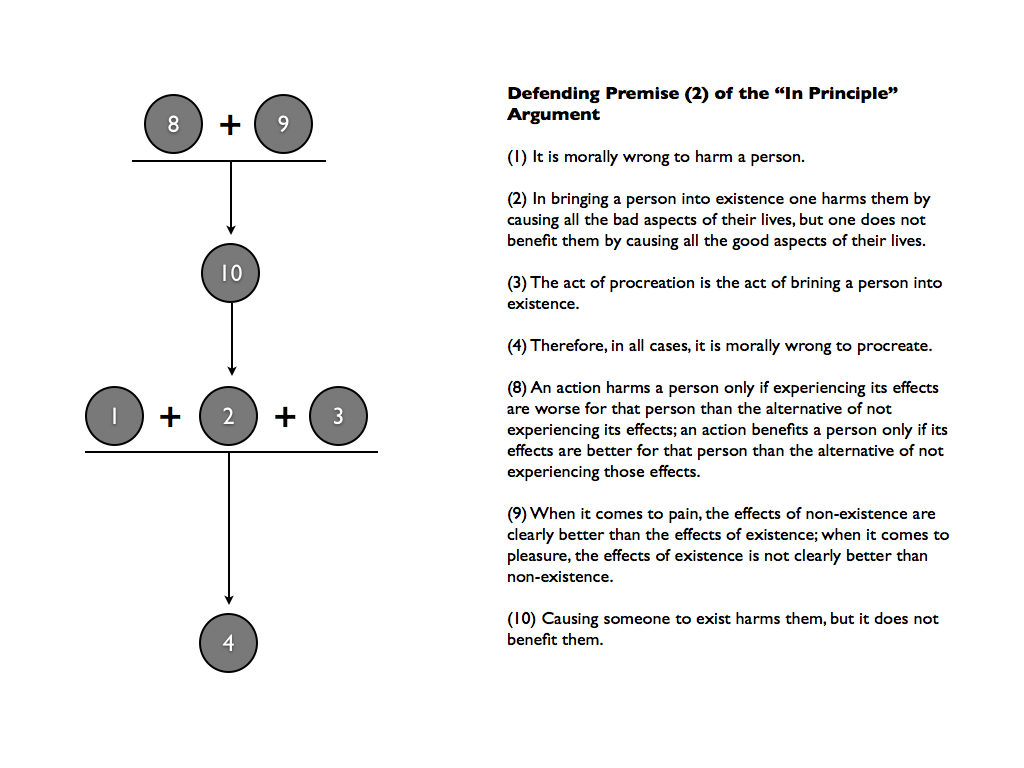
Benatar's first argument depends on a key premise (in case you're wondering the numbering follows from the previous entry):

  • (2) In bringing a person into existence one harms them by causing all the bad aspects of their lives, but one does not benefit them by causing all the good aspects of their lives.

This is very strange. It is stating that if you bring another sentient being into existence you are, morally speaking, on the hook for all the bad aspects of their life, but not all the good aspects. What reason might there be for endorsing this premise?

Benatar defends it primarily by appealing to an asymmetry thesis about the nature of pleasure and pain. The asymmetry thesis can be phrased in the following manner:

Asymmetry Thesis: The presence of pain is bad; the absence of pain is good. The presence of pleasure is good; but the absence of pleasure is not bad.

This asymmetry thesis seems, on the face of it, intuitively plausible. However, it does rely on certain ambiguities that will be challenged later on. For the time being, we can take it as is and follow Benatar in using it to identify four morally relevant facts about existence and non-existence.

(a) If we procreate and bring a being into existence there are two relevant facts: 
  • (i) The being experiences pain (which is bad) 
  • (ii) The being experiences pleasure (which is good)

(b) If we do not procreate and thereby fail to bring a being into existence there are two relevant facts: 
  • (iii) No pain is experienced (which is good) 
  • (iv) No pleasure is experienced (which is not bad)

We can arrange all of this information into the following table.


2. The Comparison Principle
Now that we have all the relevant facts with respect existence and non-existence in place, what do we do next? Answer: we perform some sort of comparison of the available options.

I suspect, for most people, the natural method to employ when comparing the options would be to first work out the overall advantages/disadvantages of existence and measure them against the overall advantages/disadvantages of non-existence. I’d call this the “natural aggregative comparison principle”.

Employing this principle, you would find that existence leads to some good things and some bad things, while non-existence leads to some good things and no bad things. But, obviously, this wouldn’t by itself imply that existence is a bad thing. What would matter is whether the good aspects of existence outweighed the bad aspects and, if so, whether they in turn outweighed the good aspects of non-existence.

Like I said, that seems like the natural way to perform the required comparison. This is not the method that Benatar uses. And it’s easy to see why not: if he did use this method, his first argument would simply reduce to his second and so would fail to provide independent support for his overall conclusion.

So what kind of comparison principle does Benatar use? He proposes that, in lieu of the aggregative principle, we employ a kind of knockout system of comparison. This means that first we measure fact (i) against fact (iii), and then we measure fact (ii) against fact (iv), and then reach some overall inclusion. Or, to put it another way, we measure things along the pain metric first, and the pleasure metric second. Call this “Benatar’s comparison principle”.

Doing this, we will find, according to Benatar, that non-existence has a clear advantage over existence when it comes to pain. After all, the non-existence of pain is good whereas the existence of pain is bad. Contrariwise, we will not find that existence has a clear advantage over non-existence when it comes to pleasure. This is because the existence of pleasure is good, but the non-existence of pleasure is basically neutral or neither bad nor good.

On the face of it, this comparison principle is outright bizarre. And it’s not clear from Harman’s review whether Benatar offers any sort of defence of it. But I’ll leave it to one side for now because there is a deeper question to be asked.


3. The Argument for Premise 2
The deeper question is: assuming Benatar’s comparison principle is legitimate, what sort of conclusions can be drawn from it? Remember, the goal here is to offer some sort of support for premise (2).

Harman offers one potential route that Benatar can take from the comparison principle to (2). I’ll sketch this out here. It begins with the following principle (again numbering continues from part one):

  • (8) An action harms a person only if experiencing its effects are worse for that person than the alternative of not experiencing its effects; an action benefits a person only if its effects are better for that person that the alternative of not experiencing those effects.

As Harman notes, this is one way in which to make sense of Benatar’s comparison principle. According to (8), harm and benefit are contrastive concepts: something is only harmful if it is worse than its alternative and something is only beneficial if it is better than its alternative.

Although I agree with Harman that this makes sense of Benatar’s comparison principle, it does so at quite a cost. I, for one, certainly don’t think harm and benefit can only be understood in contrastive terms. Anyway, nevermind. Let’s continue.

If we combine (8), with the results of Benatar’s comparison exercise:

  • (9) When it comes to pain, the effects of non-existence are clearly better than the effects of existence; when it comes to pleasure, the effects of existence is not clearly better those of non-existence.

We can draw the following conclusion:

  • (10) Causing someone to exist harms them, but it does not benefit them.

Which is pretty much the equivalent of (2). So we’ve done it, we’ve moved from the asymmetry thesis to the desired conclusion. Or have we?


4. Some Criticisms
I think there are lots of problems with this argument. As noted above, I can’t see the justification for the comparison principle. What’s more, I’m not convinced that (9) is true. Even if non-existence is not bad, it doesn’t follow that existence is not better. At least, I can’t see how it follows. Surely the pleasure derived from existence could make it better than the alternative of not existing?

There are other problems as well. Harman mentions three, which I’ll summarise here.

First, the asymmetry principle equivocates on the difference between something that is impersonally bad and something that is personally bad. Roughly, something is personally bad if it is harmful to a particular individual; whereas something is impersonally bad if it is harmful irrespective of whether any particular individual is affected by it. We might think of this in terms of observer or stance independent values and stance dependent values.

The most natural way to read the first part of the asymmetry thesis is as a claim that the absence of pain is impersonally good. This is the most natural way because the thesis as a whole asks us to imagine a situation in which a person does not exist and then ascribes goodness to that state due to the absence of pain.

This creates a problem for Benatar because if the absence of pain is only impersonally bad, then it does not follow that we harm a person by bringing them into existence to experience pain. That would only follow if the absence of pain were good for that particular person. But this can’t be the case here, because Benatar’s counterfactual involves a scenario in which the person does not exist.

In a footnote, Harman writes that, in communication with her, Benatar has clarified that he is making a claim about personal, as opposed to impersonal goods. This, as Harman points out, leads to a second problem. If the absence of something that would have been bad for a person is good for that person even in a world in which they do not exist, then why is it not equally true that the absence of something that would be good for a person is bad for a person even in a world in which they do not exist?

That’s quite a mouthful, but I think it makes sense. It can also work the other way round. If it’s impersonal goods that matter, then why would it not be true that the absence of pleasure in the world is impersonally bad?

To put it more generally, it seems like whatever can be said in favour of the first part of the asymmetry thesis can also be used to deny the second part.

The third problem with Benatar’s argument is that the intuitions motivating our initial acceptance of the asymmetry thesis can be best explained using concepts other than goodness or badness. To be precise, it seems like Benatar is mixing up theories of good with theories of right action.

I suspect most people would agree that we have strong prima facie reasons to avoid inflicting pain on other human beings, but that we have only weak reasons to make people’s lives more pleasurable. To put it in the usual philosophical language, avoiding harm seems to be obligatory whereas bringing about pleasure is supererogatory. This effectively accounts for the asymmetry thesis but does so in the language of right actions.

The problem for Benatar is that it does not follow from this version of asymmetry that the absence of pleasure is neither bad nor good (as he seems to claim) or that we breach any moral obligation in trying to bring it about. The existence of pleasure might be a very good thing indeed, and we would be well within our moral rights to bring it into existence. This runs contrary to Benatar's main conclusion.

Okay, that’s it for now. In the final part, we’ll briefly consider Benatar’s second argument and then address the implications of his argument.

Thursday, May 12, 2011

Harman on Benatar's Better Never to Have Been (Part One)


I had an interesting conversation the other day. It was about philosophers who seem to defend bizarre or controversial views. Unsurprisingly, David Benatar's name came up. Benatar, in case you don't know, is an anti-natalist. He thinks it is wrong to bring people into existence (i.e. to procreate) and he presents his view in a book called Better Never to Have Been. He's not the only anti-natalist, but his book seems to have gained a high level of notoriety, perhaps given its publication by Oxford University Press.

Anyway, after that conversation, it occurred to me that although I was aware of the basic conclusion that Benatar defends, I knew next to nothing about his actual arguments. So I decided to do something to remedy this gap in my knowledge. Of course, ideally, I should have just read his book but since I didn't have access to it, I tried to seek out some commentary on it instead. The most helpful resource I discovered after an internet-based search was also one of the first I came across: It was the following:


Based on my reading, this seems like a fair, but critical philosophical analysis of Benatar's book, and I want to summarise some its content here. I'm also going to use it as my basis for trying to clarify Benatar's arguments to myself. Obviously, the kind of analysis I'm going to undertake isn't a replacement for reading Benatar's original work, but what with time constraints and everything I think it is a reasonable place to start.

Before I get started I want to draw attention to one point. I don't find anti-natalism as counter-intuitive as some people I have spoken to seem to do. Indeed, I suspect there are many (actual) cases in which procreation is morally circumspect, particularly if it is done without proper foresight and planning for the child's future. That said, I do find it hard to accept that all cases of procreation are morally circumspect and that existence is, in general, awful. Anti-natalists would have to do a lot to convince me of this. Let's see if Benatar, filtered through the lens of Elizabeth Harman, is up to that task.

In this first part, I'll just introduce Benatar's two arguments. I'll try to evaluate them in the second part.


1. Benatar's First Argument
Benatar defends one basic conclusion using two, independent, lines of argument. The conclusion, as was hinted at above, is that procreation is, in all cases, wrong. What are the arguments? We'll develop versions of each below. Initially, we can note that both arguments rely on the generally accepted principle that it is wrong to harm someone (although they might, as I will suggest, interpret that principle in slightly different ways). This principle has an obvious corollary, namely: it is morally right to benefit someone.

Benatar's first argument relies on the idea that in bringing someone into existence one is harming them by causing all the bad aspects of their lives, but not benefitting them by causing all the good aspects of their lives. Incorporating this basic idea into our reasoning we can develop (through some creative reading) the following argument in favour of Benatar's conclusion:

  • (1) It is morally wrong to harm a person.
  • (2) In bringing a person into existence one harms them by causing all the bad aspects of their lives, but one does not benefit them by causing all the good aspects of their lives.
  • (3) The act of procreation is the act of brining a person into existence.
  • (4) Therefore, in all cases, it is morally wrong to procreate.

Obviously, premise (2) is pretty crucial here and we'll have to see what kind of argument Benatar can construct in its favour. One other thing to note is that in this argument the harm principle is phrased in a categorical or absolute way - i.e. "it is never right to harm a person" - instead of in a non-absolute or consequentialist way. I'm not sure, based on this one article, whether Benatar would agree with this reconstruction of the principle, but it seems appropriate given the kind of argument he offers in favour of premise (2), which we'll be considering later. That said, I think a non-absolute version could be substituted here without doing too much damage to our appreciation of the argument (mainly because it seems to have other, more serious, defects).


2. Benatar's Second Argument
Moving on, the second argument relies on a much more straightforward aggregative empirical claim about the overall goodness and badness of life. As follows:

  • (5) It is morally wrong to harm a person (unless the harm achieves some outweighing benefit).
  • (6) All lives are overall very bad and not worth living.
  • (7) The act of procreation causes a person to have a life.
  • (4) Therefore, in all cases, it is morally wrong to procreate.

Although this argument is pretty easy to follow, a couple of things need to be said about it here. 

First, in her review, Harman says that Benatar only claims that "most lives are overall very bad". I have changed that, in my reconstruction of the argument, to "all lives are overall very bad". This comes in premise (6). I made the change for the obvious reason that without it the strong conclusion that Benatar reaches does not follow. At best, the conclusion reached would be that most cases of procreation are morally wrong (which, as noted in the intro, I might be willing to accept). Of course, this makes the argument more difficult to defend.

Second, as you can see, this argument relies on a consequentialist version of the harm principle. This version makes sense given the kind of aggregative claim embedded in premise (6): if we were absolutists about the wrongness of harming someone then assessing the overall level of harm would not be a meaningful exercise. 

The consequentialist permission of some level of harm can be understood in different ways. In the argument given, all forms of harm are permitted if they lead to some greater good. This is a pretty weak requirement. A stronger version of the principle would stipulate that harm is only permitted if it is necessary for achieving some greater good. This should actually be familiar to anyone who read my series on skeptical theism and the problem of evil. There, the idea was that God could only allow whatever evils were (logically) necessary for achieving some greater good.

Again, based on reading just this one article, I have no idea how Benatar would like the principle to be understood. I've opted for the weak version here. Again, as was the case with the first argument, I don't think this matters too much because all the real philosophical action lies elsewhere.


3. Comments
Benatar's two arguments are combined and illustrated in the following map.


The key point to bear in mind is that the arguments are supposed to provide independent lines of support for the same conclusion. This is significant since one of the arguments clearly provides stronger support for the conclusion than the other. It would be bad if it turned out that the stronger argument reduced to the weaker argument

Which argument is stronger? Obviously, the first argument because it is an "in principle" argument. It states that, given the conceptual nature of harms and benefits, it is necessarily wrong to bring a person into existence. If this is true, it would be impossible to disagree. This stands in stark contrast to the second argument, which is a contingent, a posteriori argument. It states that, given the nature of existence as it currently stands, it is wrong to bring a person into existence. The weakness here is twofold: (i) this is an empirical claim that could be quite difficult to prove and (ii) the contingent facts could change such that existence ceases to be so harmful (e.g. if certain transhumanist goals are obtained).

Given the relative strengths of the arguments involved, and the practical difficulty in evaluating the second argument in this forum, the second part of this series will focus almost entirely on the first argument.