Sunday, January 8, 2017

Moral Arguments for God (2): Non-Evidential Forms

[If you like this blog, consider signing up for the newsletter...]

(Previous Entry)

God and morality are often yoked together. Many religious believers think that morality is not possible without God. And some religious believers use this alleged dependency between God and morality as the basis for an argument in favour of his existence. As I noted in part one, there are two main forms that these arguments take:

Evidential Arguments: These are arguments that highlight the existence of some moral fact (E) and argue that God is the best explanation of E. This provides some support for the existence of God.

Non-Evidential Arguments: These are arguments that highlight some moral goal or end and argue that God’s existence is necessary if that goal or end is to be achieved.

We looked at evidential arguments and their problems in part one. Today we’ll look at non-evidential arguments. Once again, I’ll be taking my lead from Peter Byrne’s article ‘Kant and the Moral Argument’, which is to be found in Jeffrey Jordan’s book Key Thinkers in Philosophy of Religion. Since Kant is himself a proponent of a non-evidential argument, and since Byrne’s essay is ostensibly about Kant, it is not surprising that the analysis of Kant’s argument takes up more space in Byrne’s article than did the analysis of the evidential arguments. I tend to find non-evidential arguments less interesting, for reasons that will become apparent, but I am trying to be sympathetic in my summary/commentary.


1. Kant’s Non-Evidential Argument
I mentioned in part one that non-evidential arguments are less common than evidential ones, but that if you read a lot of religious philosophy you’ve probably come across one or two of them. William Lane Craig, for instance, often appeals to non-evidential arguments in his writings. He thinks that moral values make no sense under atheism because, in order to have a coherent moral life, we need to have ‘ultimate accountability’. That is to say, we need to know that:

…Evil and wrong will be punished; righteousness will be vindicated. Despite the inequities of life, in the end of the scales of God’s justice will be balanced. 
(Craig, Is Goodness Without God Good Enough?)

Here, Craig is identifying a moral goal that needs to be satisfied if moral life is to be possible. He is then suggesting that it is not possible without God. The problem with atheism is that life ends at the grave. I could be a total moral jerk my whole life and not be punished for it; I could be a total moral saint and suffer needlessly. The morality or immorality of my behaviour need have no bearing on my ultimate fate. That seems wrong to Craig. Morality should count for something in the end.

I’ve discussed this argument on a previous occasion and explained what I think is wrong with it. Kant’s non-evidential argument turns out to be quite similar in its form. The only difference is that where Craig emphasises ultimate accountability, Kant emphasises ultimate goodness (which requires a combination of happiness and complete virtue). Byrne reconstructs Kant’s argument like this (I have modified this slightly):


  • (1) It is rationally and morally necessary to attain the highest good (perfect happiness arising out of complete virtue)
  • (2) What we are obliged to attain, it must be possible for us to attain (i.e. ought implies can).
  • (3) Attaining the highest good is only possible if natural order and causality are part of an overarching moral order and moral causality.
  • (4) Natural order and causality can only be part of an overarching moral order and moral causality if God exists.
  • (5) Therefore, it is rationally and morally necessary for God to exist.


Byrne doesn’t actually provide a conclusion in his version of the argument. I have done so because I think the argument needs to reach some sort of conclusion, even if it turns out to be a misleading or unimpressive one.

Let’s now consider some objections to this Kantian argument.


2. Five Objections to the Kantian Non-Evidential Argument
Byrne isn’t terribly explicit about this but by my reading of him he presents five different objections to the Kantian argument. They all have different targets (see diagram above). The first targets the conclusion of the argument:


  • (6) Even if successful, the argument does not prove that God exists or that morality is impossible without him; it only proves that his existence is necessary for us to live moral lives.


There are unsubtle and subtle aspects to this. The subtle point is that this argument does not rule out the cognitivity of moral propositions in an atheistic universe. For all this argument says, it could be true that propositions like ‘torturing cats is wrong’ and ‘friendship is good’ are true and God not existent. In other words, it is possible to accept this argument and still be an atheistic moral realist (i.e. someone who believes that moral facts do not depend on God for their existence).

The unsubtle point is that the argument clearly does not provide evidence for God’s existence. It could be, for all this argument says, that we live in a completely amoral, indifferent universe. The argument is premised on a hope or aspiration; not a concrete fact about the morality of the world in which we live. As such, the argument does not count among the epistemic proofs of God’s existence. It might count, instead, as a rational proof of God, i.e. a proof that God’s existence is subjectively necessary: that we cannot live without believing in him. The problem with this ‘rational proof’ interpretation is that it casts the argument in a very different light. It suggests that belief in God is what matters; not his actual existence. This means that the conclusion that I offered above should be altered to the following:


  • (5*) Therefore, it is rationally and morally necessary to believe in God’s existence.


And this throws open the possibility of believing in God as a useful moral fiction. The theist would resist this, no doubt. They would point back to the first premise and argue that mere belief is not enough: we have to have the possibility of attaining the highest good and this means we need God to actually exist, not just exist in our minds. This runs into the promotion vs attainment objection that I discuss below.

The second objection to the argument is this:


  • (7) It is not clear that the attainment of happiness is rationally/morally necessary, partly because it is not clear what happiness consists in.


This is an attack on premise (1). Byrne explains the objection by pointing out that the nature of happiness is contested and, depending on which definition you adopt, people often give up the pursuit of happiness for the attainment of other goods. So, for example, if happiness is understood as hedonistic pleasure, it seems true to say that people will subject themselves to displeasurable states of affairs in order to attain other goods. I might hate studying for exams, for example, but I accept the displeasure in return for an education. A better example, and one given by Byrne, is that of someone giving up their career to care for a sick relative. The former made them happy whereas the latter does not, but they find the latter more rationally and morally compelling.

Byrne detects three distinct accounts of happiness in Kant’s work: a pleasure-based theory; a contentment-based theory; and a desire-satisfaction based theory. The problem is that these three theories pull in different directions. It is possible that the pleasure-filled life is not the life in which the most desires are satisfied. I often pursue momentary pleasures at the expense of long-term desire satisfaction. Does this make me more or less happy? Likewise, contentment is a very different notion from pleasure or desire-satisfaction. I can be content with my lot in life and not experience much pleasure.

The point here is that happiness is a deeply contested concept and given its deep contestation its not at all clear that it’s attainment is rationally and morally compelling. For what it is worth, I’m not sure that this is a good objection. The mere fact that there is uncertainty as to what a goal consists in does not mean that it is not morally or rationally necessary. We may simply need a wide and capacious understanding of what it is. On top of it, it feels intuitively correct to suggest that the pursuit of happiness (understood broadly) is the ultimate goal of human life.

But this is to speak only to happiness and not virtue. For Kant, it was essential for virtue and happiness to align, i.e. for true happiness to be only attainable by living the morally virtuous life. For this, God was deemed essential. I previously mentioned that in an atheistic universe it seems eminently possible for someone to live an immoral and vicious life and yet to be happy (in some sense of the term). This is the great fear of theists like Kant and Lane Craig. They think God is necessary to ensure some alignment between virtue and happiness.

This insistence, however, gives rise to a third objection. This one is somewhat specific to Kant’s understanding of how God ensures that virtue and happiness align. I’ll state it bluntly first and then explain:


  • (8) Kant implies that virtue requires endless progress and hence implies that true happiness is unattainable. This is contrary to premises (1) and (2) of his argument.


In his Metaphysics of Morals, Kant states that:

Virtue is always in progress and yet always starts again from the beginning. The first point holds because, considered objectively, it is an ideal and unattainable, even though it is a duty to approximate constantly to it. 
(Quoted in Byrne 2011, 90)

And in the Critique of Practical Reason, Kant suggests that virtue (or what he there calls ‘holiness’) requires immortality because it involves the constant asymptotic approach to a perfect ideal. This seriously undercuts the non-evidential argument because it suggests that even with God it is impossible to attain true happiness. Immortality seems to be doing all the work; not God.
On some occasions, Kant modifies his talk about endless pursuit by suggesting that God can decree that the pursuit itself is sufficient, but this then opens up another objection:


  • (9) Why is it not enough to simply promote the ultimate good? Why do we need to actually attain it?


One should always be wary of objections phrased as rhetorical questions, but in this instance the question seems like a good one. Surely we can respect the need for some moral ideals, perhaps we can even accept that having those moral ideals in mind is necessary if we are to live moral lives, but why is it morally and rationally necessary to actually attain them, particularly if this is ultimately impossible? The second premise of Kant’s argument puts down his famous ‘ought implies can’ principle. It states that we are only morally obliged to do that which it is possible to do. Well, it is possible to promote moral good; but it may not be possible to achieve moral perfection. This suggests that the former is what is rationally and morally necessary; not the latter. This, therefore, undercuts the first premise of the argument.

Which brings us to the last objection. This one targets premise (4):


  • (10) There could be some impersonal moral force that binds the naturalistic order to the moral order.


In other words, we don’t need the Western, personal, monotheistic God in order to ensure that moral goals are attainable. All we need is some impersonal moral force. Some Eastern religions believe in such forces, e.g. karma. Of course, the tenability of this objection depends very much on the plausibility of this metaphysical view. Somewhat ironically, whether you believe in the possibility of impersonal moral forces is likely to depend on how you feel about evidential moral arguments (the kind of arguments discussed in part one).

Thursday, January 5, 2017

Hume's Objections to the Design Argument (Part Two)


[If you like this blog, consider signing up for the newsletter...]

(Part one)

This is the second in a two-part series on David Hume’s objections to the design argument. If you haven’t read part one, I would recommend doing so before going any further. To briefly recap, in part one I mentioned that Hume’s treatment of the design argument — primarily in his Dialogues but also in his Enquiry — is lauded by many. JCA Gaskin is particularly impressed by it and dedicates a good portion of his book Hume’s Philosophy of Religion to its analysis.

In Gaskin’s reading of Hume, there are two versions of the design argument with which to contend:

The Nomological Design Argument: which focuses on the order/regularity that is found in nature and argues that some designer must be responsible for it.

The Teleological Design Argument: which focuses on the purpose/adaptation that is found in nature and argues that some designer must be responsible for it.

Both versions of the argument are defended by the character of Cleanthes in the Dialogues. They are then challenged by the character of Philo (often thought to represent Hume’s own views). Gaskin identifies ten different objections to both design arguments in Hume’s writings. These ten objections are organised into four main groups, illustrated in the diagram below. We dealt with the first two groups in part one. Let’s now look at the other two.


1. Analogical Weaknesses
The nomological and teleological arguments rest on an analogy. In Cleanthes presentation, we are entitled to infer that there is some designer of the order/purpose that we see in the natural world because our experience with the artificial world tells us that whenever there is order/purpose there is some human designer behind it all. In other words, the arguments are explicitly constructed in such a way that the natural and artificial worlds are deemed to be similar enough to ground an analogical inference. Hume has several objections to this attempted analogy.

The first of his objections is (numbering continues from part one):

(5) The ‘Weak and Remote’ Problem: ‘The analogy between those objects known to proceed from design and any natural object is too weak and too remote to suggest similar causes.’ (Gaskin 1988, 27 - citing an argument found in several locations in the Dialogues)

To understand this objection we need to understand how analogical arguments work. They all have the following structure:


  • P1. Y is true in Case A.
  • P2. Case B is like Case A in all important respects (i.e. with respect to features X1…Xn).
  • P3. Therefore Y* (similar to Y in important respects) is likely to be true in Case B.


In my more detailed presentation of the design arguments in part one, I showed how this abstract structure could be applied to both the teleological and nomological arguments. This application is not important right now. The critical detail for now is how all analogical arguments depend upon a similarity claim. It is because Case B is similar to Case A with respect to features X1…Xn that the inference can be made. The more similar the two cases are, the stronger that inference is; the more different they are, the weaker it is.

Hume’s challenge to both versions of the design argument is to suggest that the two cases (natural order/purpose and artificial order/purpose) are not very similar at all. They do not share as many features as proponents of the argument like to suggest and those that they do share are, upon closer inspection, more dissimilar than we might first think. There are many examples of this in practice. The purpose we see in the design of non-human animals and plants can often be opaque and bizarre. Think about the instances of ‘bad’ design that we see in nature — examples like the laryngeal nerve of the Giraffe, the vestigial thumb of the Panda, and all manner of cruel and painful livelihoods that are eked out by predators and prey. These examples are all better explained by Darwinian evolution, of course, but if we set that to the side and seriously entertain the design hypothesis we have to acknowledge that we are dealing with a designer with very different purposes or intentions to any human designer — ones that are ‘beyond our ken’.

On top of this, there is a scale and immensity to the order we see in the universe that makes its construction something quite beyond the abilities of any human designer. This might seem to warrant the inference to a supreme being with the powers traditionally attributed to God, but for Hume the dissimilarities of scale serve to undercut the analogy used to ground the design argument:

All the new discoveries in astronomy, which prove the immense grandeur and magnificence of the works of nature…become so many objections, by removing the effect still farther from all resemblance to the effects of human art and contrivance. 
(Hume’s Dialogues — quoted in Gaskin 1988, 30)

This brings us to the next objection:

(6) The Non-Agential Order Problem: ‘Order, arrangement, or the adjustment of final causes is not, of itself, any proof of design; but only so far as it has been experienced to proceed from that principle.’ (Hume’s Dialogues - quoted in Gaskin 1988, 31)

This is a little bit tricky to understand. Hume makes two points in relation to this objection. The first is that when you look at the totality of human experience, the evidence we have for thinking that order/purpose proceeds from agency is pretty flimsy. The second is that we have some reason for the thinking that order can be brought into existence without agency. Both points require some elaboration.

The first point is probably the more subtle one and its significance may be underappreciated. Look around the world. Look at all the instances of order/purpose that you find in it. How many of those instances of order/purposes are known — independently of the design argument — to proceed from agency? The answer is very few (proportionately speaking). Humans have had a remarkable impact on the world around them, but it is still true to say that the natural world (including the universe as whole) is much larger than the human created world and contains in it many instances of order/purpose that are not known — independently of the design argument — to proceed from agency. This is a problem because the strength of the analogy underlying the design argument is dependent on the totality of the available evidence regarding design in the universe. It’s only if we are more certain, based on our experience, that design is brought about by an agent that we can infer that all instances of design must have an agential origin.

Another way of putting it might be like this: we frequently reason from samples of the whole to explanations of the whole. We are entitled to reason from small samples if there are good grounds for thinking that they are representative of the whole (think about the way in which polling data is collected from samples). But in the case of the design argument, there is no good reason for thinking that the small sample of human-created design is representative of the whole. On the contrary, the total background evidence we have suggests that most instances of design do not have an agential creator. So we cannot reason by analogy from the few cases of human-created design to the assumption that there is a designer for the whole.

The second point Hume makes is more straightforward. It is simply that there are known cases in which order is brought about by non-agential forces. Certain geological processes, for example, are non-agential and yet can result in orderly patterns. Similarly, most people would agree that plants are not agents and yet when they grow and develop, plants create order in the world around them. So here we have some direct counter-analogies: cases in which design is not the product of a designer.
Some theists might object to this on the grounds that these examples all involve new forms of order/design being created from previous forms of order/design. Thus, the non-agential forces to which Hume appeals do not explain the origins of order/design in the first place. That’s as may be, but in making this move, the theist is shifting to a different kind of argument — something more akin to the cosmological argument — which tries to suggest that there must be a first link in a chain of causation. The regress problem — discussed below — challenges this style of argument.

The last of Hume’s three analogical objections is this:

(7) The Tightrope Problem: The design arguments try to walk a very fine line between excessive anthropomorphism and incomprehensible remoteness when it comes to the nature of the designer. It is very difficult to walk this line and maintain the credibility of the design argument.

This objection functions like a dilemma. Suppose the theist is right and the analogy between artificial order/purpose and natural order/purpose is strong. In that case, the strength of the analogy means we should infer a very human-like designer. We would then end up with something that falls a long way short of the supreme being beloved by theists. Contrariwise, suppose the theist is wrong and the analogy is not strong — the scale and magnitude of the universe points to a being with properties very distinct from a human creator. In that case, they might be able to get to the supreme being they desire, but at the cost of undercutting the analogy they were originally using to support their case.
So theists have to walk a very fine line — a tightrope if you will — one that insists that the two cases are just similar enough to warrant the inference to a designer and also different enough to enable them to insist that the designer is a supreme, non-human like being.

In fact, for Hume, it gets worse than that because not only do theists have to walk that line when it comes to the design argument, they also have to walk that line with their very conception of God. The God they want has to be human-like in some ways (with a human like mind/personality and moral interests in humanity’s affairs) but also practically incomprehensible and ineffable in others (omnipotent, omniscience, perfectly simple etc.).


2. Problems in Explaining Order/Purpose
This brings us to the final branch of Hume’s taxonomy of objections. There are three specific objections lying along this branch. Each of them takes issue with the motivation behind the design arguments, i.e. the desire to explain order/purpose in terms of divine agency. They each take a slightly different perspective on the issue though.

The first objection points to a general problem with all attempts to explain order/purpose:

(8) The Regress Problem: “If an intelligent agent is required to explain the order in nature then the intelligent agent will in turn need to be explained…But if we stop at the agent explanation, and go no farther; why go so far? Why not stop at the material world? How can we satisfy ourselves without going on in infinitum? And after all, what satisfaction is there in that infinite progress?” (Hume’s Dialogues - quoted in Gaskin 1988, 41)

The point that Hume (via Philo) is making in this quote is a familiar one. Anybody who has spent anytime sniffing around the philosophy of religion will have encountered some variant on it before. Hume is saying that explanations must bottom out somewhere, i.e. with some fundamental origin or source for the order/purpose we see. Theists want the explanation to bottom out in God: they want him to be the ground of all being. But do they have good grounds for doing so?

Hume thinks that they face two problems. First, in trying to get to God they appeal to principles that do not justify stopping with God. Thus, as noted above when discussing their objection to Hume’s plant example, they will suggest that there must be some fundamental origin to the order/purpose we see in the universe: an explanation that doesn’t just explain one type of order in terms of another type of order. They think God satisfies this role, but Hume argues that he doesn’t. What is God if not an ordered, purposeful being? Appealing to Him means that we explain one type of order in terms of another type of order. But if order itself needs to be explained then we will need to find some explanation for God. Hence, the infinite regress. Some theists might think they have a response to this by arguing that God is a perfectly simple, unitary being and hence doesn’t display the kind of ordered complexity that they think is needs to be explained. But Hume has a reply to this:

A mind whose acts and sentiments and ideas are not distinct and successive, one that is wholly simple and totally immutable, is a mind which has no thought, no reason, no will, no sentiment, no love, no hatred; or, in a word, is no mind at all.
(Hume's Dialogues, Part IV) 


The other problem that theists face is that if they accept that there cannot be an infinite regress of explanations, they will need to justify going beyond the laws of nature in explaining the order/purpose we find in the universe. As Hume puts it: If we have to stop somewhere, ’why not stop at the material world?’ We might be justified in seeking a further explanation for the laws of nature if the explanation we posit can provide us with greater insight/understanding of those laws. But Hume argues that God does not provide this additional insight. On the contrary, God is usually a deeply mysterious explanation, with little or no explanatory power or predictive potential. Of course, theists disagree, but I tend to think Hume is right on this score: appeals to the explanatory power of God are usually little more than an attempt to explain one mystery in terms of something even more mysterious.

The next objection takes a different tack and suggests that there are, in any case, alternative naturalistic explanations for the order/purpose we see in the universe:

9. The Alternative Explanations Problem: There is a ‘system, an order, an economy of things, by which matter can preserve the perpetual agitation, which seems essential to it, and yet maintains a constancy in the forms’ (Hume’s Dialogues - quoted in Gaskin 1988, 43)

This is obscurely expressed but it is the shortest summary of one of Philo’s more complex arguments in the Dialogues. In one sense, what Philo argues is more appealing to us nowadays than it was in Hume’s time. Remember, when Hume wrote the Dialogues Darwin was yet to expound his theory of evolution by natural selection. This theory — and subsequent developments of it — provided a compelling (to most, at any rate) naturalistic explanation for the purpose and adaptation we see in the living world. Hume had to defend an alternative naturalistic explanation without the benefits of Darwinism. But Gaskin argues that Hume anticipated Darwin’s ideas in the following passage:

It is vain, therefore, to insist upon the uses of the parts in animals and vegetables, and in their curious adjustment to each other. I would fain know how an animal could subsist, unless its parts were so adjusted? Do we not find, that it immediately perishes whenever this adjustment ceases, and that its matter corrupting tried some new form? 
(Hume’s Dialogues — quoted in Gaskin 1988, 44)

Did you spot the anticipation of Darwin? It’s a little hard to see, but in this short quote Hume does mention two things that are redolent of Darwinism. First, he points to something akin to a Darwinian selection pressure when he says that he would ‘fain know how an animal could subsist [i.e. survive], unless its parts were so adjusted?’. Second, he seems to suggest that something akin to mutation (‘matter corrupting’) could be responsible the animal forms that survive and subsist. This is, of course, a generous interpretation, conducted with all the benefit of hindsight.

In any event, offering a naturalistic explanation for the purpose and adaptation we see in living nature is only half the battle. There is still the question of where all the order and regularity in the universe as a whole came from. Here, it seems that Hume paid homage to the classic Epicurean view. According to this view, the universe is an infinite soup of matter in motion. Much of that motion is chaotic and disordered. But if the universe is truly infinite, there will, of necessity, be localised pockets of order and we, as ordered beings, will necessarily find ourselves in those localised pockets. Thus, in an infinite universe in which all possibilities are eventually tried out, there is nothing explanatorily surprising about our existence:

Thus the universe goes on for many ages in a continued succession of chaos and disorder. But is it not possible that it may settle at last, so as not to lose its motion and active force…yet so as to preserve a uniformity of appearance amidst the continual motion and fluctuation of its parts? This we find to be the case with the universe at present…May we not hope for such a position, or rather be assured of it, from the eternal revolutions of unguided matter, and may not this account for all the appearing wisdom and contrivance which is in the universe? 
(Hume’s Dialogues — quoted in Gaskin 1988, 46)

The challenge for this Epicurean view lies in contemporary cosmology. We know much more about the universe in which we live now than we did in Hume’s day. The scientific evidence we currently have suggests that our universe started at a finite point in the past and that the matter within it obeys fairly uniform laws. This seems to rule out the possibility of the infinite, churning chaos that Hume requires. But this isn’t quite right either. Our current scientific model of the universe is incomplete in certain important respects and the finite duration of the portion of the universe in which we live and do our science doesn’t rule out the possibility that we are part of some larger, infinite chain of universes or multiverses. Indeed, some scientific theories point in that direction already. So the Humean alternative may still be viable, and I find it appealing on philosophical grounds (viz. positing an infinite chaos in which everything that is possible happens seems like the neatest and most satisfactory explanation of everything).

Hume has one last objection to theistic attempts to explain order/purpose:

10. The Cognitive Limitation Problem: Human reason is a poor instrument for working out universal truths. We should be sceptical of all our attempts to explain the ultimate origins of reality.

This is theme that runs throughout Hume’s philosophical works. He is the arch-sceptic. He thinks that human reasoning is weak and highly fallible. It doesn’t deliver the results we would like. We cannot even justify simply practices like scientific induction on the basis of reason alone. Consequently, we should be very sceptical of any attempt to use these weak and fallible capacities to explain the origins of order/purpose.

I’m not sure if I completely follow Hume on this front. I think we should be sceptical of the powers of human reason but I tend to sympathise more with the view Hume attributes to Cleanthes in the Dialogues, namely: complete scepticism is unwarranted and human reason can provide us with some insights. It’s really all about the domain of inquiry: whether human reason is up to the task in that domain. I might agree with Hume that religious matters are one area where human reason is not up to the task. JL Schellenberg is probably the contemporary philosopher who has done the most to take up Hume’s cudgels on this front. His book The Wisdom of Doubt presents the best argument I know of for religious scepticism of the Humean type (though note: Schellenberg is more optimistic about the long-term prospects for human reason). I recommend it to anyone who would like to pursue this tenth line of objection in more depth.


3. Conclusion

That brings us to the end of this analysis of Hume’s objections to the design argument. To sum up, Hume focuses on two versions of the design argument: the nomological and the teleological. The former is concerned with the order/regularity we observe in the natural world; the latter is concerned with the purpose/adaptation we observe in the natural world. Hume levels ten objections against these two arguments. These objections have been discussed in detail over the two posts in this series. I won’t repeat the details here.

As you no doubt noticed, there are parts of Hume’s critique that are quite antiquated. He concerned himself with the religious debates and views of his day and he wrote at a time when our scientific understanding of biology and cosmology was in its infancy. Nevertheless, much of what he says continues to have relevance, and it always amazes me to see how closely Hume’s reasoning resembles or anticipates what we find in contemporary philosophy of religion.

Let me close, however, on a more critical note. Hume deals with an explicitly analogical version of the design argument in his writings. One problem with this is that most modern defenders of the design argument abjure the analogical form. They favour arguments that are couched in Bayesian terms or in terms of inference to best explanation. It sometimes turns out that these formulations of the argument rely, implicitly, on some analogy between human design and divine design, but to reveal that implicit reliance you have to engage with some complex debates in probability theory and theories of explanation. I still think that parts of what Hume says are relevant to those debates, but it requires more work to demonstrate this.

Tuesday, January 3, 2017

Hume's Objections to the Design Argument (Part One)


[If you like this blog, consider signing up for the newsletter...]

Le Bon David (as he was to his French fans and friends), David Hume (to the rest of us) was one of the most loved philosophers of his time (although Rousseau may disagree). And many is the contemporary philosopher that professes attachment to his work. There is something exhilarating and remarkably fresh about his muscular empiricism and naturalism, his commitment to common sense, and his scepticism of all things metaphysical. His outlook and temperament is almost quintessentially that of the modern, naturalist philosopher. And when it comes to contemporary naturalism most of what is said has its origins in Hume.

I first encountered Hume through his work on religion. The Dialogues Concerning Natural Religion was a formative book for me. As the title suggests, it is a philosophical dialogue very much in the Platonic mould. It recounts the after-dinner conversation and debate among three protagonists: Cleanthes, Philo and Demea. Cleanthes is a proud defender of natural theology (the belief that argument and evidence points to God); Philo is a religious sceptic (often thought to be a mouthpiece for Hume’s own views); and Demea is something of fideist, believing that God’s existence is already known to all and that philosophy can, at best, tell us something about His nature. Demea says relatively little throughout the dialogue; Cleanthes and Philo dominate the discussion. At the centre of their debate rests the design argument.

In this post (and the next) I want to share their analysis of that argument. Many philosophers have been impressed by the way in which Hume — through Philo — dismantles the logic of the design argument. Some go so far as to suggest he dealt the argument a killer blow — though this must surely be contested. JCA Gaskin is one of those who is impressed by Hume’s treatment of the design argument. His book Hume’s Philosophy of Religion provides a comprehensive exposition of Hume’s reasoning. Gaskin claims that Hume deals with two distinct versions of the design argument in the Dialogues and that he levels ten objections to these two versions of the argument. I want to go through all ten of these objections in what follows.


1. Two Design Arguments and a Taxonomy of Objections
I need to start by distinguishing the two versions of the design argument that are found in Hume’s work. There is no better place to go for these than the inital presentation of the design argument in the Dialogues. In part two, Cleanthes says the following:

Look around the world: Contemplate the whole and every part of it: You will find it to be nothing but one great machine, subdivided into an infinite number of lesser machines, which again admit of subdivisions, to a degree beyond what human senses and faculties can trace and explain. All these various machines, and even their most minute parts, are adjusted to each other with an accuracy, which ravishes into admiration all men, who have ever contemplated them. The curious adapting of means to ends throughout all nature, resembles exactly, though it much exceeds, the productions of human contrivance; of human design, thought, wisdom and intelligence. Since therefore the effects resemble each other, we are led to infer, by all the rules of analogy, that the causes also resemble; and that the Author of nature is somewhat similar to the mind of man, though possessed of much larger faculties, proportioned to the grandeur of the work, which he has executed. By this argument…we prove at once the existence of a Deity. 
(Dialogues, Part II)

At first glance, this looks like one argument, based on an analogy. In abstract form, the analogy works like this:


  • P1. Case A: Some observed effect (X) in the world around us.
  • P2. Case A is like Case B (which involves some observed effect Y) in all important respects.
  • P3. In Case B, P is the cause of Y.
  • C1. Therefore, in Case A, P* (similar to but slightly different from P) is likely to be the cause of X.


In Hume’s discussion the variables in this argument are filled in with observations about the natural and artificial (man-made) worlds. But in Gaskin’s reading there are two different observed effects that get the argument going. The first is the observation of order in nature (the ‘nature is like a machine’ observation); the second is the observation of purpose (i.e. the ‘adapting of means to ends’ observation). This gives rise to two distinct versions of the argument from design. The first can be called the argument from regularity (or the nomological argument):

The Nomological Argument
(1) We observe order/regularity in the natural world. 
(2) The natural world and the artificial man-made world are similar in all important respects. 
(3) In the artificial world, wherever there is order and regularity it is because there is some designer/architect that is responsible for that order/regularity. 
(4) Therefore, there is likely to be some designer/architect of the order/regularity in nature.

The second can be called the argument from adaptation (or the teleological argument)

The Teleological Argument
(1*) We observe purpose/adaptation of means to ends in the natural world. 
(2*) The natural world and the artificial man-made world are similar in all important respects. 
(3*) In the artificial world, wherever there is purpose/adaptation it is because some designer/architect is responsible for that purpose/adaptation. 
(4*) Therefore, there is likely to be some designer/architect of the purpose/adaptation in nature.


Many discussions of Hume have tended to fixate on the teleological version of the argument. One reason for this is that Darwinian evolutionary theory got going in the century after Hume and provided a good naturalistic explanation for the adaptation of means to ends that impresses Cleanthes in the Dialogues. Thus we tend to find that argument much less persuasive nowadays. But Gaskin argues that the nomological argument is the version of the argument with the deeper pedigree. Furthermore, one could argue that the nomological argument has undergone a renaissance in the past half century in the guise of the argument from fine-tuning (though there are definitely discrepancies between the two argument and nothing said in this series of posts should be taken to have much bearing on that more recent version of the argument from design). So the distinction is of some historical philosophical significance.

It is also of more practical philosophical interest. Some of the criticisms Hume levels against the design argument really only find their mark if we have one version in mind. That said, it is still worth treating them as a pair and that is what we shall do for the remainder of this series. Whenever a criticism is raised that is limited in its reach to one version of the argument rather than the other, this will be made clear to the reader.

Now that we know something about the structure of the design argument(s), we can turn to their critical evaluation. As mentioned, Gaskin argues that Hume (through Philo) levels ten objections against the argument. These ten objections can be organised into a taxonomy. There are four major branches to this taxonomy. Each branch features a different general style of objection, which in turn breaks down into a number of more specific objections. As follows:

A. Restrictions on the Conclusion: These are objections that highlight the weakness of the conclusion of the argument. 
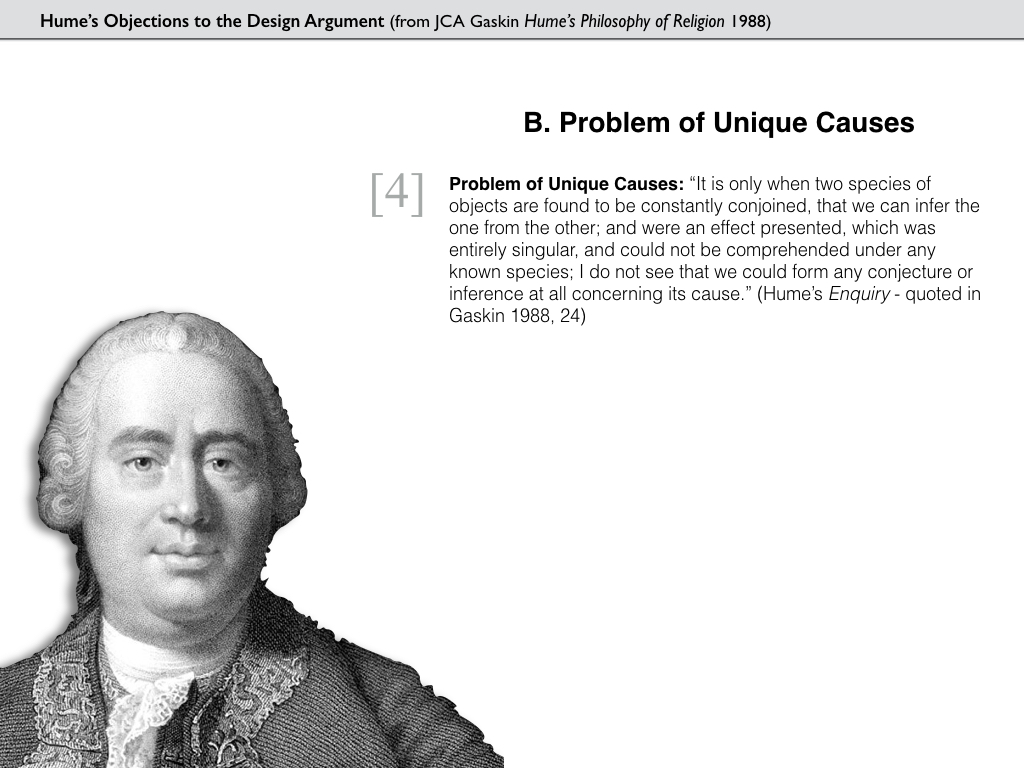
B. Problem of Unique Causes: This is an objection (there is only one of these) that is based on Hume’s famous theory of causation, roughly the idea is that it is difficult to make inferences about the causes of unique effects; the universe is a unique effect; hence it is difficult to make inferences about its cause. 
C. Analogical Weaknesses: These are objections that highlight weaknesses in the analogy underlying both forms of the argument.

D. Problems in Explaining Order/Purpose: These are objections that block the argument by either offering alternative explanations of the order/purpose we see in the universe or by highlighting problems with the explanation of order.

The full taxonomy of objections, with the ten specific forms, is illustrated below. This may not mean too much to you right now, but we will go through each branch in what follows. I’ll do the first two branches in the remainder of this post and the other two in the next post.


2. Restrictions on the Conclusion
The centrepiece of the design argument, in both the teleological and nomological forms, is the analogy between the natural and artificial worlds. The claim is that because we know that the order/purpose we see in the artificial world is the result of human agency and design we can infer, by analogy, that the order/purpose we see in the natural world is the result of divine agency and design. The first set of objections leveled by Philo in the dialogues takes issue with this inference to divine agency. In essence, he argues that the analogical argument cannot get the theist all the way to God.

There are three specific forms of this objection. I will give each of the objections a name and number. I do so both to facilitate recall. When Gaskin introduces these objections he also tends to include some original quotation from Hume’s writings to back it up. I will follow suit here whenever possible, but note that not all of the text comes from the Dialogues. Although the Dialogues contains pretty much all the objections, it does not always express these objections in the most efficient philosophical form. This is a result of the dialogic form of writing, which lends itself to aesthetic flourishes that occasionally distract from the main line of reasoning.

Anyway, here’s the first specific objection:

(1) What-you-see-is-what-you-get (WYSIWYG) problem: “If the gods are the cause of order in the universe, then they possess that degree of power, intelligence and benevolence which appears in their known effect (the world) and nothing more.” (Hume’s Enquiry)

In other words, when you are inferring from an effect to a cause, you are only entitled to infer a cause with the properties that are necessary to explain what you see in the effect, nothing more. When I find a letter in my postbox, I am entitled to infer that someone delivered it. I am not entitled to infer that the person who delivered it had red hair, was in a bad mood, and suffered from gout — at least, not unless additional evidence, that would entitle me to make those inferences, can be found. I can only make those inferences that are supported by what I see. The same goes for inferences from the order and purpose we see in the world around us. From those effects we might be entitled to infer some sort of designer, but we are not entitled to infer what theists typically infer, which is a supreme being with maximal virtues, who cares profoundly about human well-being, has a plan for our salvation, and will reward us with everlasting life if we are lucky/do the right things. Inferring those additional properties brings us outside the realm of the analogy.

Richard Swinburne has lodged a complaint against this line of reasoning. He argues that if we accepted Hume’s WYSIWYG principle, then scientific inquiry and explanation could never get off the ground. Scientific explanation always involves explaining one thing in terms of something else (something more fundamental and with different properties). For example, the scientific explanation of what it means to be alive doesn’t appeal to some cause with ‘life-giving’ properties. Instead, it appeals to metabolic chemical processes within cells and DNA replication and transmission. These biochemical entities and activities seem to have properties that, taken individually, are very different those we associate with being alive and yet, when organised in the right way, they manage to exemplify the property of being alive.

In essence, Swinburne critiques Hume for adopting an explanatory principle for which medieval scholastics were ridiculed. Gaskin defends Hume by suggesting that Hume would agree with Swinburne on the preferred form of scientific explanation. But Hume would counter that we are only entitled to explain one thing in terms of something very different when we have independent epistemic access to that other thing. Thus, we are entitled to explain what it means to be alive in terms of biochemical processes because we are able to probe, interrogate and experiment with those processes independently of observing their effects in living beings. It’s not like we observe a chicken scratching its way around a farmyard and then magically infer the underlying biochemical processes from these behavioural effects. Instead, we slice and dice the living tissues of the chicken, view them under a microscope, manipulate their component parts through experimentation, and slowly build up an understanding of the underlying biochemistry.

The situation with respect to God and the design argument is very different. We cannot experiment with God. We only have epistemic access to God through his effects in the world and so we are only entitled to make those inferences about his nature that are justified by those effects. Hume puts it like this in the Enquiry Concerning Human Understanding:

The Deity is known to us only by his productions and is a single being in the universe, not comprehended under any species or genus, from whose experienced attributes or qualities we can, by analogy, infer any attribute or quality in him. 
(Quoted in Gaskin 1988, 18)

In essence, the problem for the theist is that they are presuming to know more about God than the design argument can actually establish. By the logic of the design argument alone, you cannot infer a designer with all of the properties typically ascribed to God.

The WYSIWYG principle has further consequences for the theist. This comes in the guise of the second objection, one which Philo makes much of in the Dialogues:

(2) The Evil Effects Problem: “The true conclusion [of the design argument] is, that the original source of all things is entirely indifferent…and has no more regard to good above ill than to heat above cold.” (Hume’s Dialogues).

The idea here is that the effects we observe in the world contain both good and evil. Because they contain this mix of properties, we are not entitled to infer from them a designer that is all good. At most, we are entitled to infer a designer that is morally indifferent. This objection is closely allied to the problem of evil, but is not quite the same thing. It is not presented here as a general reason for disbelieving in God but rather as a reason to doubt that the design argument gets us to God. In this manner, the argument Philo is defending in the Dialogues is very similar to the so-called ‘Evil God’ argument that has been defended by Stephen Law (among others). The essence of Law’s argument is that all the observable evidence in the universe points just as much in favour of an Evil God as it does of a Good God.

The second objection is really just a specific instance of the first objection. The third objection is a little different. It claims that the principle of analogy underlying the argument supports alternative design hypotheses. Philo mentions three in particular in the Dialogues and Gaskin treats them as a group in his analysis:

(3) Multiple Design Hypotheses Problem: If valid, the design argument could establish a number of design hypotheses, such as: (a) the universe is the product of a committee of designers; (b) the universe is a discarded experiment of an old or second rate deity; or (c) the universe has been designed to run on its own devices and the creator plays no further part in its unfolding.

The theist wants the argument to point to a traditional monotheistic God: a single, all-powerful creator of the universe, who is still interested in his creation and has a salvific plan for it. Hume, however, says that the design argument cannot give you that God. The principle of analogy underlying it provides just as much support for multiple Gods, discarded experiments and deistic gods. In human experience, we know that designed objects, particularly when they are complex, are often the products of teams of designers, not single individuals. We also know from human experience that some designed objects are just experiments, occasionally discarded and often bug-ridden. Finally, we know from human experience that it is possible for machines to be created and left to operate until their eventual destruction without further interference from their original creators. So analogies between the artificial and the natural do not point straightforwardly to one God.

Swinburne and others have challenged this by suggesting that other explanatory desiderata point to a monotheistic God. Ockham’s razor, for example, tells us that when you are trying to explain some phenomenon you should posit the simplest explanation possible. To Swinburne, Hume’s claims about the possibility of a committee of Gods involves positing a more complex explanation where a simpler one will do. Furthermore, Swinburne submits that the unity of nature (the fact that everything in the universe seems to fit under a shared set of scientific laws) points to a unity of creation (that it is all the product of one supreme mind).

Gaskin defends Hume from this counterargument by highlighting the fact that Hume was well aware of the need to posit simple explanations. But this desideratum is not supreme and its application can be limited by other factors. Hume’s point was that human experience suggests that complex designed phenomena are usually the product of committees and teams, not individual effort. The weight of experiential evidence — the very evidence we use to support the original analogy — thus favours the committee hypothesis.

And, what’s more, the evidence for unity in nature might be overstated. It might be true that all parts of nature are consistent with some underlying set of physical laws, but this does not mean that all parts of nature can be explained in terms of those laws. Try as we might, we cannot explain all of biology in terms of physics, or all of psychology in terms of biochemistry, or all of economics in terms of psychology. There appear to be distinct explanatory principles ruling across multiple emergent domains of human interest. This is what we might expect from a committee of designers, each of whom takes responsibility for a different part of the total creation.


3. The Problem of Unique Causes

We are moving on now to the second branch of the taxonomy of objections. Fortunately, there is only one specific objection on this branch so it’s a nice place to end the discussion for today. The objection itself is almost uniquely Humean and has its origins in his views about causation. This view of causation is found primarily in Hume’s Enquiry, but Philo echoes it in the Dialogues. Gaskin introduces it like this:

(4) Problem of Unique Causes: “It is only when two species of objects are found to be constantly conjoined, that we can infer the one from the other; and were an effect presented, which was entirely singular, and could not be comprehended under any known species; I do not see that we could form any conjecture or inference at all concerning its cause.” (Hume’s Enquiry - quoted in Gaskin 1988, 24)

Hume’s view of causation is roughly this: you can only say that events of type A cause events of type B if you repeatedly observe events of type A being conjoined to events of type B. Cold weather can be said to cause frost and ice only because we repeatedly observe the conjunction of the cold with frost and ice in space and time. If we observe an event of type A being conjoined to an event of type B on just one occasion, then we are not entitled to infer any causal relationship. Hume does not believe that causality is something that can be readily and easily inferred. He was sceptical of philosophers who thought you could observe necessary causal relationships between events.

This creates a problem for the theist because they are trying to make an inference about the cause of a singular event or state of affairs, namely: the existence of the universe. By definition, there is just one universe and hence only one observation we can make about its occurrence. This is not enough to make a causal inference about its origins.

The challenge to the Humean view is that there are examples of seemingly unique events for which we readily (and convincingly) make causal inferences. Swinburne argues that much of modern cosmology is like this, as are certain aspects of anthropology and archaeology. We find a single object in a dig site and infer a human designer; we observe a cosmological event (e.g. the cosmic microwave background radiation) and infer a single cause (the Big Bang). Why can’t we do the same for the universe as a whole?

The problem with this response is that the examples used are not that convincing. We do not simply infer unique causes from unique events in cosmological or archaeological settings. In the archaeological case, we use our understanding of how humans work, the objects they like to make, the design principles they use, and use all of this background knowledge to make a causal inference. In the cosmological case, we use our understanding of how matter works in the present era to make inferences about how it was likely to behave in the past. Also, we do, in fact, now have experiments running that try to recreate the conditions in the early universe, allowing us to check our scientific theories against repeated observations of reality.

In all these cases, we are making causal inferences about events that are internal to the universe and we can use our background knowledge of how the universe works to guide our causal inferences. The situation is very different when we make inferences about the universe as a whole and posit some external cause. In that case, our background knowledge of the universe is of no assistance.

Or is it? Gaskin’s discussion of this objection is odd because it ends with a concession. Gaskin notes that the whole point of the argument from analogy is to suggest that the universe as a whole belongs to a class of objects (machines) about which we do have considerable background knowledge, and which background knowledge can be used to guide causal inferences about the creation of the universe. Thus, the analogical argument seems to sidestep this whole Humean line of reasoning. Of course, Hume has a response to this. He thinks it only manages to sidestep the objection if the analogy underlying the argument is sufficiently strong. That’s something that his next batch of objections calls into question. We’ll cover those objections in part two.


Saturday, December 31, 2016

Top Ten Posts of 2016


2016 -- Twenty sixteen -- generally regarded as a pretty bad year all around: Celebrities getting killed by old age, illness and substance abuse; long-cherished liberal democracies turning into reality shows etc etc... Rejoice! It is now over!

It wasn't a bad year on this blog though. Nothing spectacular, probably not as a good as 2015, but not awful. Here are the top ten posts going by page views from the past year (ignoring posts from previous years that continue to receive a lot of hits for unknown reasons):


  • Are we Heading Towards a Singularity of Crime? (March 2016) - My review and analysis of Marc Goodman's book Future Crimes, which introduces a fascinating argument that we are heading for a singularity of crime, but never defends it explicitly. I try to make up for that in this post.

  • Technological Unemployment and the Meaning of Life: Should we retreat from reality? (November 2016) - The text of a talk I gave in Germany in early November (the night that Donald Trump got elected to be precise). In it, I argue that we need to take the case for technological unemployment seriously and, more importantly, look for ways to address the deficit in meaning that might be caused by a lack of work. I explore, in particular, the possibility that virtual worlds will provide the necessary meaning.

  • The Value of Deep Work and How to Prioritise It (January 2016) - One of my self-helpy blog posts, looking at the ideas in Cal Newport's book Deep Work. I am a fan of the book. It's one of the few self-help books with an underlying philosophy of work that I agree with (though not entirely).

  • The Philosophy of Social Constructionism (December 2016) - Lots of people claim that gender and race are socially constructed, but what do they mean by this? This post looked at some philosophical attempts to clarify the answer. Based on the work of Esa Diaz-Leon.

  • Competitive Cognitive Artifacts and the Demise of Humanity (September 2016) - This was one of the more fun posts to write. It was my attempt to formalise and critique an argument by David Krakauer. He argued that artificial intelligences posed a threat to humanity because they compete with human intelligence rather than complement it.


  • Is Resistance Futile? Are we already Borg? (January 2016) - My analysis and critique of David Gunkel's argument about human cyborgification. Although I agree with Gunkel that humans are becoming cyborgs, I think his definition and understanding of cyborgification is too limited. I also interviewed David for my podcast. You can listen to that interview here.

  • Effective Altruism: A Taxonomy of Objections (January 2016) - The first in a long-ish series of posts about potential objections to effective altruism. The series riffed off Iason Gabriel's excellent article on the topic and ended with a contribution from Iason himself. You can read the full series here.


Podcasts and other Media Appearances 2016


As my penultimate end-of-year-review post, I thought I would provide links to some of the media appearances and mentions I had in the past year. I'm not going to list everything. For instance, my paper on sex work and technological unemployment was featured on several news websites but without anyone interviewing or talking to me first and often with its main thesis ignored -- I discussed this in my first newsletter back in September. So I'm really only including media appearances and mentions here that occurred with some contact between myself and the relevant outlets, or, exceptionally, where I felt they did a good job representing what I have written (Ronald Bailey's article, below, is the only real example of this).


Podcast Appearances


  • ’Algocracy’ - Interview about my research project and podcast on the Robot Overlordz Podcast, Episode 284


Radio


Television


Articles


Wednesday, December 28, 2016

The Algocracy and Transhumanism Podcast (Episodes 2016)


Guests in 2016. (Top row left to right: Aaron Wright; Laura Cabrera; Evan Selinger; Hannah Maslen; Karen Levy) (Middle row: James Hughes; Sabina Leonelli; Anders Sandberg; David Gunkel; Sven Nyholm; Brett Frischmann) (Bottom row: Tal Zarsky; Deborah Lupton; Nicole Vincent; Rachel O'Dwyer; Rick Searle)


I've been doing a podcast since April of this year (2016). It's part of a research project I am running at NUI Galway about algocracy and transhumanism. I think I've covered a broad range of interesting topics with my guests so far. Here's a list of all episodes to date. You can listen by clicking on the links or the player underneath the description. You can also subscribe to the podcast here and here.


#1 - Tal Zarsky on the Ethics of Big Data and Predictive Analytics: Covers basic definitions of big data and predictive analytics and then discusses issues surrounding the fairness and efficiency of such systems. Listen here or below.


#2 - James Hughes on the Transhumanist Political Project: Covers the history of transhumanist thought, its origins in the Enlightenment project, and its modern variations. Listen here or below.


#3 - Sven Nyholm on Love Drugs, Deep Brain Stimulation and Self Driving Cars: Covers the use of enhancement drugs to improve interpersonal relationships, the ways in which DBS can affect personal identity and why the trolley problem is a bad starting point for debates about self-driving cars. Listen here or below.


#4 - Evan Selinger on Algorithmic Outsourcing and the Value of Privacy: Covers the ethics of personal automation software and the critical question of whether privacy is dead in an age of mass surveillance. Listen here or below.

#5- Hannah Maslen on the Ethics of Neurointerventions: Covers attempts to directly interfere with the brain and their ethical implications. Particular attention is paid to how neurointerventions affect autonomy, responsibility and regret. Listen here or below.

#6 - Deborah Lupton on Understanding the Quantified Self: Covers the emergence of the Quantified Self movement, its manifestations and its social and ethical consequences. Listen here o below.


#7 - Brett Frischmann on Reverse Turing Tests and Machine-Like Humans: Covers the classic Turing test (when is a machine like a human?) and Frischmann's proposed inverse test (when is a human like a machine?). Listen here or below.


#8 - Karen Levy on the Rise of Intimate Surveillance: Covers self-tracking technologies that are directed at intimate behaviours (finding partners, quantifying sex, romance and fertility, and covert surveillance of partners). Listen here or below.


#9 - Rachel O'Dwyer on Bitcoin, Blockchain and the Digital Commons: Covers the concept of the digital commons, the nature of money, the tracking of transactional data, and the potential for blockchain-based currencies. Listen here or below.


#10 - David Gunkel on Robots and Cyborgs: Covers robot personhood, responsibility and patiency, as well as the cyborgification of humans. Listen here or below.


#11 - Sabina Leonelli on Big Data and Science: Covers the ways in which big data systems are being used in scientific inquiry and challenges the claim that they are revolutionising the process. Listen here or below.


#12 - Rick Searle on the Dark Side of Transhumanism: Covers the political-philosophical musings of Zoltan Istvan, Steve Fuller and the neo-reactionary movements. Listen here or below.


#13 - Laura Cabrera on Enhancement, Communication and Human Values: Covers the potential impact of enhancement technologies on interpersonal communication and important human values. Listen here or below.


#14 - Aaron Wright on Blockchains and the Law: Covers the nature of blockchain technologies, its potential uses and its social and legal implications. Listen here or below.

#15 - Nicole Vincent on Neurointerventions and Happiness: Covers the philosophical definition of happiness, the role of scientific advice in the pursuit of happiness and the possibility of radical personal transformation. Listen here or below.

#16 - Anders Sandberg on the Ethics of Time Compression in Computing: Covers the increase in computing speed and the consequences of the widening speed mismatch between computers and humans. Listen here or below.


Tuesday, December 27, 2016

Academic Papers Published in 2016


It's that time of the year again. The time when all self-respecting bloggers construct self-congratulatory lists of their annual achievements. Here are all the articles I had accepted for publication in 2016 (I'm excluding some book chapters that aren't due out until next year):


Why Internal Moral Enhancement Might be Politically Better than External Moral Enhancement (2016) Neuroethics DOI: 10.1007/s12152-016-9273-8 - Technology could be used to improve morality but it could do so in different ways. Some technologies could augment and enhance moral behaviour externally by using external cues and signals to push and pull us towards morally appropriate behaviours. Other technologies could enhance moral behaviour internally by directly altering the way in which the brain captures and processes morally salient information or initiates moral action. The question is whether there is any reason to prefer one method over the other? In this article, I argue that there is. Specifically, I argue that internal moral enhancement is likely to be preferable to external moral enhancement, when it comes to the legitimacy of political decision-making processes. In fact, I go further than this and argue that the increasingly dominant forms of external moral enhancement (algorithm-assisted enhancement) may already be posing a significant threat to political legitimacy, one that we should try to address. Consequently, research and development of internal moral enhancements should be prioritised as a political project.

LINKS: Official; Philpapers; Academia


An Evaluative Conservative Case for Biomedical Enhancement (2016) Journal of Medical Ethics 42:611-618 (Editor's Choice) - It is widely believed that a conservative moral outlook is opposed to biomedical forms of human enhancement. In this paper, I argue that this widespread belief is incorrect. Using Cohen’s evaluative conservatism as my starting point, I argue that there are strong conservative reasons to prioritise the development of biomedical enhancements. In particular, I suggest that biomedical enhancement may be essential if we are to maintain our current evaluative equilibrium (i.e. the set of values that undergird and permeate our current political, economic, and personal lives) against the threats to that equilibrium posed by external, non-biomedical forms of enhancement. I defend this view against modest conservatives who insist that biomedical enhancements pose a greater risk to our current evaluative equilibrium, and against those who see no principled distinction between the forms of human enhancement.

LINKS: Official; Philpapers; Academia


Should we use commitment contracts to regulate student use of cognitive enhancing drugs? (2016) Bioethics 30(8): 568-578 - Are universities justified in trying to regulate student use of cognitive enhancing drugs? In this paper I argue that they can be, but that the most appropriate kind of regulatory intervention is likely to be voluntary in nature. To be precise, I argue that universities could justifiably adopt a commitment contract system of regulation wherein students are encouraged to voluntarily commit to not using cognitive enhancing drugs (or to using them in a specific way). If they are found to breach that commitment, they should be penalised by, for example, forfeiting a number of marks on their assessments. To defend this model of regulation, I adopt a recently-proposed evaluative framework for determining the appropriateness of enhancement in specific domains of activity, and I focus on particular existing types of cognitive enhancement drugs, not hypothetical or potential forms. In this way, my argument is tailored to the specific features of university education, and common patterns of usage among students. It is not concerned with the general ethical propriety of using cognitive enhancing drugs.

LINKS: Official; Philpapers; Academia


Robots, Law and the Retribution Gap (2016) Ethics and Information Technology 18(4): 299-309 - We are living through an era of increased robotisation. Some authors have already begun to explore the impact of this robotisation on legal rules and practice. In doing so, many highlight potential liability gaps that might arise through robot misbehaviour. Although these gaps are interesting and socially significant, they do not exhaust the possible gaps that might be created by increased robotisation. In this article, I make the case for one of those alternative gaps: the retribution gap. This gap arises from a mismatch between the human desire for retribution and the absence of appropriate subjects of retributive blame. I argue for the potential existence of this gap in an era of increased robotisation; suggest that it is much harder to plug this gap than it is to plug those thus far explored in the literature; and then highlight three important social implications of this gap.

LINKS: Official; Philpapers; Academia


Will life be worth living in a world without work? (2016) Science and Engineering Ethics DOI: 10.1007/s11948-016-9770-5 - Suppose we are about to enter an era of increasing technological unemployment. What implications does this have for society? Two distinct ethical/social issues would seem to arise. The first is one of distributive justice: how will the (presumed) efficiency gains from automated labour be distributed through society? The second is one of personal fulfillment and meaning: if people no longer have to work, what will they do with their lives? In this article, I set aside the first issue and focus on the second. In doing so, I make three arguments. First, I argue that there are good reasons to embrace non-work and that these reasons become more compelling in an era of technological unemployment. Second, I argue that the technological advances that make widespread technological unemployment possible could still threaten or undermine human flourishing and meaning, especially if (as is to be expected) they do not remain confined to the economic sphere. And third, I argue that this threat could be contained if we adopt an integrative approach to our relationship with technology. In advancing these arguments, I draw on three distinct literatures: (i) the literature on technological unemployment and workplace automation; (ii) the antiwork critique — which I argue gives reasons to embrace technological unemployment; and (iii) the philosophical debate about the conditions for meaning in life — which I argue gives reasons for concern.

LINKS: Official; Philpapers; Academia